
Road salt is not dirt, it is mineral residue. It dissolves in meltwater, dries as a white haze, and the crystals left behind are abrasive enough to scratch a floor finish underfoot. Water alone spreads it. The fix is a damp pass with a neutral cleaner, repeated through the season.
Why does road salt leave a white haze on floors?
Because what comes in on your boots is not mud. Chicago streets, sidewalks and building entrances get treated with rock salt and chloride blends from the first freeze onward, and what arrives on your floor is salt dissolved in slush.
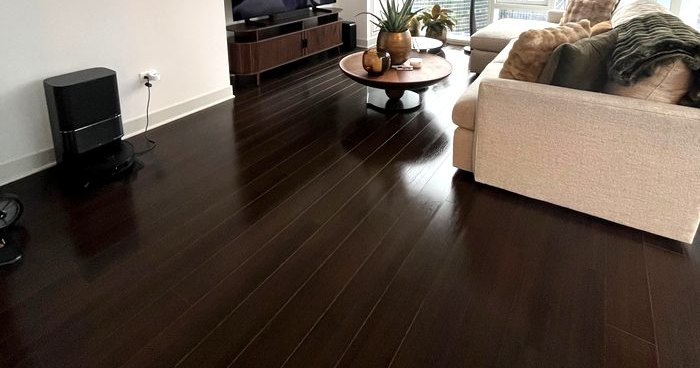
The water evaporates. The salt does not. It recrystallises on the surface as a chalky white film, and it does it most visibly on exactly the floors people in this city have: dark stained hardwood, dark tile, anything with a sheen.
That is also why the haze keeps coming back after you mop. Salt is water soluble, so a wet mop dissolves it instantly and then carries it across the rest of the floor in solution. You have not removed anything. You have thinned it out and spread it over a wider area, and when that water dries you get the same film across the whole room instead of a patch by the door.
If this sounds familiar, it is the same category of problem as the mineral film on Chicago shower glass. In both cases the thing you are looking at is a mineral deposit, not soil, and ordinary all-purpose spray is the wrong tool.
Does salt actually damage hardwood?
Yes, in two separate ways, and the slower one is the one that costs money.
The first is abrasion. Dry salt crystals are hard and angular. Left on a floor and walked over, they behave like grit: every step grinds them into the finish. Over one winter of daily traffic in an entryway that produces a dulled, scuffed patch in the highest traffic metre of the room, and that is finish damage rather than dirt. No amount of later mopping brings the sheen back.
The second is moisture. Salt is hygroscopic, which means it pulls water out of the air and holds it. A salt deposit sitting in the seams between boards keeps a little moisture there long after the floor looks dry. On hardwood that is what leads to cupping, lifting edges and white marks in the finish over time.
Tile is more forgiving on both counts, but grout is not. Salty meltwater sits in grout lines, dries there, and leaves a pale crust that gets harder to shift the longer it is left.
What removes salt residue without stripping the finish?
The sequence matters more than the product. Dry first, damp second.
- Vacuum or sweep before any water touches the floor. This is the step almost everyone skips, and skipping it is what turns a small problem into a hazy floor. Lift the dry crystals out while they are still dry.
- Go over it damp, not wet. A well wrung microfibre flat mop with a pH neutral floor cleaner. Standing water is the enemy on hardwood regardless of salt.
- Change the water far more often than feels necessary. Once the bucket is salty you are reapplying salt. Two passes with clean water beats four with dirty water.
- Dry the entry area afterwards. A quick pass with a dry microfibre cloth at the door, where the volume is heaviest.
On the vinegar question, which comes up every year: it does dissolve salt residue, and plenty of guides recommend a diluted vinegar rinse. It is also an acid. Keep it away from natural stone entirely, because marble, limestone and travertine etch on contact. On sealed hardwood an occasional diluted rinse is unlikely to cause harm, but making it your weekly routine for four months is how a finish goes dull. A pH neutral cleaner does the same job without the risk.
Two things to avoid outright: a steam mop on hardwood, because you are driving heat and moisture into exactly the seams where salt has already parked water, and a stiff brush or scouring pad on a finished floor, which solves a haze by creating scratches.
What about carpet, rugs and entry mats?
Carpet hides the problem rather than avoiding it. Salt works down into the pile and the backing, where it keeps attracting moisture and stiffens the fibres. The white tide lines that show up on a hallway runner by February are salt that has wicked up as the carpet dried.
Vacuum entry carpet and runners more often than you would in summer, in slow overlapping passes rather than quick ones, because the deposits sit low in the pile. Blot fresh slush rather than rubbing it in. For a rug you care about, it is worth getting it out of the entryway for the winter rather than cleaning it repeatedly.
Entry mats are the one piece of equipment that genuinely earns its place. The useful kind is one you can pick up, take outside and shake out, or put through a wash. A heavy decorative mat that never moves simply becomes a salt reservoir that everyone walks over on their way in.
How do you stop it coming in at the door?
You cannot stop it, but the volume that reaches your floors is controllable, and in a high-rise the lobby and lift have usually done half the damage before you reach your own door.
- Shoes off at the entry, properly. Not just inside the door. The two steps people take while still wearing boots are where most of the deposit lands.
- A boot tray with a lip. Wet boots release salty water as they dry, and it has to go somewhere other than your floor.
- Two mats where you can. One outside the door for the worst of it, one inside to catch the rest.
- Deal with the entry floor weekly. A short, regular pass at the door is worth more than a heroic clean in March.
The entryway is also the part of the home visitors judge first, which matters more at this time of year. If you have people coming over, the guest-ready order of work puts the entry at the top of the list for the same reason.
When is it worth booking a clean instead?
Winter is the season where cleaning frequency genuinely earns its keep in this city, because the mess arrives daily rather than accumulating slowly. A home that looks fine on a fortnightly schedule in July often does not hold between visits in January.
If your floors are the main concern, a recurring plan through the salt months is the straightforward answer: the point is frequency, not intensity, because salt removed this week cannot abrade the finish next week. Our guide to how often to have your house cleaned goes through how to pick a cadence.
If the haze has already built up across a whole floor, or there are tide lines in the carpet and crust in the grout, that is a backlog rather than upkeep, and a deep clean is the thing that resets it. Then a regular schedule keeps it there for the rest of the winter.
One honest caveat: if the finish is already dulled in the traffic path by the door, cleaning will not restore it. That is refinishing work, and it is the reason the dry pass in December is worth more than any product in March.
Common questions
Does road salt damage hardwood floors?
It can. Salt crystals are abrasive, so they act like grit underfoot and dull a floor finish over a season of traffic. Salt also holds moisture against the boards, and moisture sitting in the seams is what causes the lasting damage rather than the salt itself.
What is the best way to remove salt residue from floors?
Vacuum or sweep the dry crystals up first, then go over the floor damp with a pH neutral cleaner and change the water often. Skipping the dry pass is the common mistake, because a wet mop dissolves the salt and spreads it across the whole floor as a haze.
Will vinegar remove salt stains?
It is a common recommendation and it does dissolve salt residue, but vinegar is acidic. Keep it off natural stone such as marble and limestone, and be cautious on hardwood, where repeated acidic washing can dull the finish. A pH neutral floor cleaner is the safer default.