
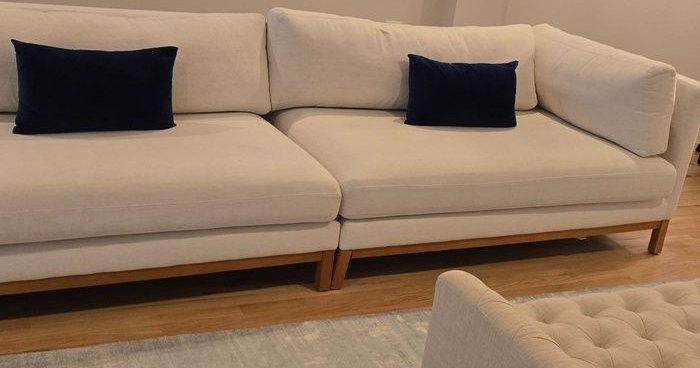
Pet hair is not a surface problem. It works into upholstery, rug pile and filters, then moves back into the room every time the heating runs. Vacuuming more often helps less than vacuuming in the right order: textiles before floors, dry removal before anything wet, filters on a schedule.
Why does pet hair come back the day after you vacuum?
Because most of it was never on the floor. A vacuum pass over hard floors and rugs collects the hair that has already settled, which is the visible minority. The rest is held in fabric: sofa cushions, the underside of throws, mattress edges, curtain hems, the fabric sides of a dog bed.
Hair is also light, and it is static-prone once it is dry. Walking across a room, sitting down heavily on a sofa, or the heating cycling on is enough to lift it back into the air, where it drifts and settles again. You did not miss it. You removed one layer and the reservoir behind it refilled the floor within a day.
This is why frequency alone disappoints people. Vacuuming the floor five times a week while never touching the sofa means you are emptying the same tray over and over while the tap runs.
Where does pet hair actually collect?
In a Chicago apartment it concentrates in a predictable set of places, and they are rarely the ones people clean first.
- Upholstery seams and under cushions. Hair migrates into the crease where the seat meets the back and compacts there.
- Rug pile, near the edges. The border of a rug collects more than the middle, because that is where foot traffic changes direction.
- Under and behind furniture. Low clearance under a sofa or bed is where hair gathers into drifts, out of sight.
- Baseboards and floor edges. Hair rides air currents to the perimeter of a room and parks against the skirting.
- Vent grilles and filters. In forced-air buildings this is the one that quietly undoes the rest of the work.
- Fabric that never gets washed. Throws, cushion covers, the cover of the pet bed itself.
The vent and filter point deserves emphasis in this city. A forced-air system pulls hair and dander in, loads the filter, and then pushes air past that loaded filter into every room. A high-rise apartment with a shedding animal can need its filter changed considerably more often than the packaging suggests, and that single habit does more for the air than any amount of surface work.
What order should you clean in?
Order is the whole thing with pets, because every step dislodges hair that then lands on whatever you cleaned before it.
- Strip the washable fabric first. Throws, cushion covers, the pet bed cover. Get them into the machine before you touch anything else.
- Work the upholstery. Rubber tool or damp rubber glove to ball the hair up, then vacuum it away. This is the step that empties the reservoir.
- Dust high surfaces and vent grilles. Everything you disturb from here falls downward, which is why this comes before the floor.
- Vacuum rugs and carpet properly. Slow, overlapping passes, then a second set at ninety degrees to the first. Hair lies directionally in pile and one direction misses half of it.
- Vacuum hard floors, then edges and under furniture. A crevice tool along the baseboards is where the drifts are.
- Mop last, and only after the dry work is done. Wet hair smears and sticks rather than lifting.
That last rule is the same principle that applies to road salt tracked in over winter: dry removal always comes before anything wet, because water turns a liftable mess into a spread one.
How do you get hair out of upholstery and rugs?
A vacuum alone struggles with hair that has woven itself into fabric, because suction pulls against fibres that are gripping. The trick is to break that grip first.
Rubber is what works. A rubber-bristled brush, a pet hair block, or just a damp rubber washing-up glove dragged across the fabric will gather hair into visible clumps that lift away in one pass. Squeegees do the same thing on low-pile rugs and are oddly effective on carpeted stair treads. Lint rollers are for finishing a jacket, not for clearing a sofa.
For rugs, a stiff brush worked against the lay of the pile brings buried hair to the surface where the vacuum can reach it. Do that before vacuuming rather than after. On a wool rug, go gently and with the pile rather than against it, since aggressive brushing will fuzz the surface over time.
Two things worth avoiding: a steam cleaner on a rug that still holds loose hair, because you will felt the hair into the pile, and a vacuum with a full bag or clogged brush bar. Hair wraps around a beater bar fast, and a wrapped bar stops agitating, which means it stops cleaning while still sounding exactly the same.
What works on dander and smell rather than hair?
Hair is the visible problem. Dander, which is skin rather than fur, is the one that affects air quality, and odour is a third thing again. They need different handling.
Dander is fine and settles everywhere, so the answer is washing and filtering rather than picking. Wash pet bedding and any soft furnishing the animal uses on a regular cycle. Use a vacuum with a sealed HEPA filter if you have the choice, because a vacuum that filters poorly redistributes the smallest particles rather than capturing them. Wipe hard surfaces with a damp microfibre cloth instead of dry dusting, which just launches dander back into the air.
Odour is almost always a source problem rather than an air problem. It is coming from a specific soft item: the bed, a rug, a patch of carpet, a favourite chair. Masking the room with spray treats the symptom and the smell returns within hours. Find the item, wash it or have it cleaned, and the room resolves itself. For accidents on carpet, an enzyme cleaner is the category that actually breaks the residue down, and it needs dwell time to work rather than being blotted straight off.
Does heating season make it worse?
It makes it more noticeable, which amounts to the same thing day to day.
From late October onward in Chicago the windows close and stay closed, and the building heats for months. Older buildings with radiators and newer high-rises with forced air both move a lot of air around, and both push settled hair and dander back into circulation. Dry indoor air adds static, and static makes hair cling to upholstery, clothing and the sides of furniture rather than falling where a vacuum can reach it.
At the same time the animal is indoors more or less constantly, so the daily deposit into the home goes up while the ventilation that used to disperse it goes away. Nothing about the animal changed. The room did. Homes that felt manageable on a fortnightly rhythm in September often do not hold that rhythm in January, which is the same seasonal shift covered in our guide to how often to have your house cleaned.
Is it worth booking a clean?
It depends on whether what you have is upkeep or backlog, and the two need different things.
If the floors look fine for a day and then do not, that is upkeep, and the answer is rhythm rather than intensity. A recurring plan through the heating months keeps the reservoir from building in the first place, which is the only approach that holds with a shedding animal.
If there is hair compacted into the sofa seams, drifts under the bed, and crust around the vent grilles, that is backlog. A deep clean is what resets it, and pet hair removal is part of that service rather than an extra. On a standard clean it is available as a paid add-on, priced separately because it is genuinely slow work: lifting woven hair out of upholstery and pile is time, not product. Our comparison of a deep clean against a general clean sets out where the line falls, and what is included as standard covers the rest.
One honest limit: no clean stops shedding. What a good clean does is reset the baseline so that normal weekly effort is enough to hold it, instead of being swallowed by a backlog that was already there before you started.
Common questions
Does a cleaning service remove pet hair?
Pet hair removal is part of a deep clean and is offered as a paid add-on to a standard clean. It is priced separately because it is slow work rather than a different product: hair woven into upholstery and rug pile has to be lifted with a rubber tool before a vacuum can pick it up.
How often should you vacuum if your dog sheds?
Two or three times a week on the main traffic routes and wherever the animal sleeps, and once a week everywhere else. Frequency matters more than thoroughness here, because hair removed this week cannot work its way deeper into the pile next week.
Does pet dander get worse in winter?
It becomes more noticeable. Windows stay shut, the heating moves air through the same rooms for months, and dander that would otherwise disperse keeps circulating indoors. The amount the animal sheds does not necessarily rise, but what is already in the home stays in it.